
A version of this screenshot lands in my inbox almost every week: a general manager's pickup report with one Saturday circled and a single question, "Is this good?" The circled date shows plus 9 rooms in seven days, and it looks healthy. Very often it is not. Split the line open and it is 14 new bookings and 5 cancellations, and most of the new business came in on a discounted OTA rate that someone forgot to close. The report is right. The reading is wrong.
I have been reading pickup reports for 18 years, first in international five-star hotel chains and now across the hotels our team at Revenuenaire manages. In 2026 the report matters more than it did a few years ago, because guests book earlier and cancel later, which means the numbers on the books move more between the day you look and the day the guest arrives. In this article I will show you exactly how I read a hotel pickup report: which columns I look at first, how I separate pickup from pace, how net pickup changes the story, and how a single line of pickup becomes a rate decision, with a worked example you can copy.
What is a hotel pickup report in 2026?
A hotel pickup report is a daily or weekly report that shows how many room nights and how much room revenue were added to each future stay date since the last snapshot, after cancellations. In 2026, hotels use the pickup report to see booking momentum by date, spot demand spikes early and decide when to change rates or restrictions.
Put simply, pickup is the difference between two photographs of your future. Take the rooms on the books for 14 November this morning, subtract the rooms on the books for 14 November seven days ago, and the result is your seven-day pickup for that date. Every property management system can produce some version of this report. The trouble is that most hotels print it, glance at the total and move on.
The report usually shows, for each future date: rooms on the books, revenue on the books, the change over one or more pickup windows (yesterday, last 7 days, last 30 days), and a comparison to the same point last year. Better versions split the change by segment (transient, group, corporate, wholesale) and by channel (direct, Booking.com, Expedia, GDS).
Why the pickup report matters more in 2026
Two booking trends have made the report more important this year. First, guests plan further ahead. The Cloudbeds 2026 State of Independent Hotels Report, built on 90 million bookings, found that travellers booked an average of 40 days in advance in 2025, up from 38 days in 2023. SiteMinder's Hotel Booking Trends 2026 report, based on more than 130 million bookings, puts the global average booking window at 32.15 days. Second, cancellations arrive later: Cloudbeds reports the average cancellation window grew to 39 days from 35 days in 2023. Longer windows mean more of your month is already on the books when you look, and more of it can still walk away.
The US market context in 2026 also rewards careful reading. CoStar and Tourism Economics raised their 2026 US forecast in August to RevPAR growth of 4.4 percent, with ADR up 3.1 percent and demand up 1.7 percent, lifted by World Cup premiums. When a market is growing mainly through rate rather than volume, the hotels that win are the ones that notice a strong date early enough to price it.
Bottom line: A pickup report is a momentum gauge for each future night, and in 2026 it is the earliest warning you get that a date is running hot or cold.
Pickup vs pace in a hotel booking report
Pickup and pace are two different hotel measurements. Hotel pickup is the change in bookings for a future date over a recent period, such as the last seven days. Hotel pace is the total on the books for that date compared with the same point in the booking cycle last year, or with budget. Pickup shows movement; pace shows position.
A simple way to remember it: pickup is speed, pace is where you are on the track. A date can have strong pickup and weak pace (bookings are arriving fast, but you started far behind). A date can have strong pace and weak pickup (you are ahead of last year, but the flow has dried up). Those two situations call for opposite actions, which is why I never let a team make a rate call from one of them alone.
| Pickup (last 7 days) | Pace (vs same time last year) | What it usually means | What I do first |
|---|---|---|---|
| Strong | Ahead | Demand is real and early | Raise rate on remaining inventory, tighten discounts |
| Strong | Behind | Late recovery, or a cheap rate is filling | Check which rate and channel the pickup came from before touching price |
| Weak | Ahead | Early demand captured, flow slowing | Hold rate, watch the next 7 days, do not discount yet |
| Weak | Behind | Genuine softness or a lost account | Find the missing segment, then act on visibility before rate |
| Negative | Any | Cancellations exceed new bookings | Look for a group wash or a single large cancellation |
Pace needs a fair comparison. If last year's date had a citywide event and this year's does not, a pace gap is not a signal. In 2026 that problem is real for US hotels: CoStar notes the World Cup lifted June and July rates, and its 2027 ADR forecast of 1.6 percent rises to 2.1 percent once the World Cup months are excluded. Comparing next summer against this summer without adjusting for that will make most host-city hotels look behind when they are not.
Bottom line: Read pickup and pace side by side for the same date, because either number alone will send you the wrong way about half the time.
Hotel pickup report columns I read first
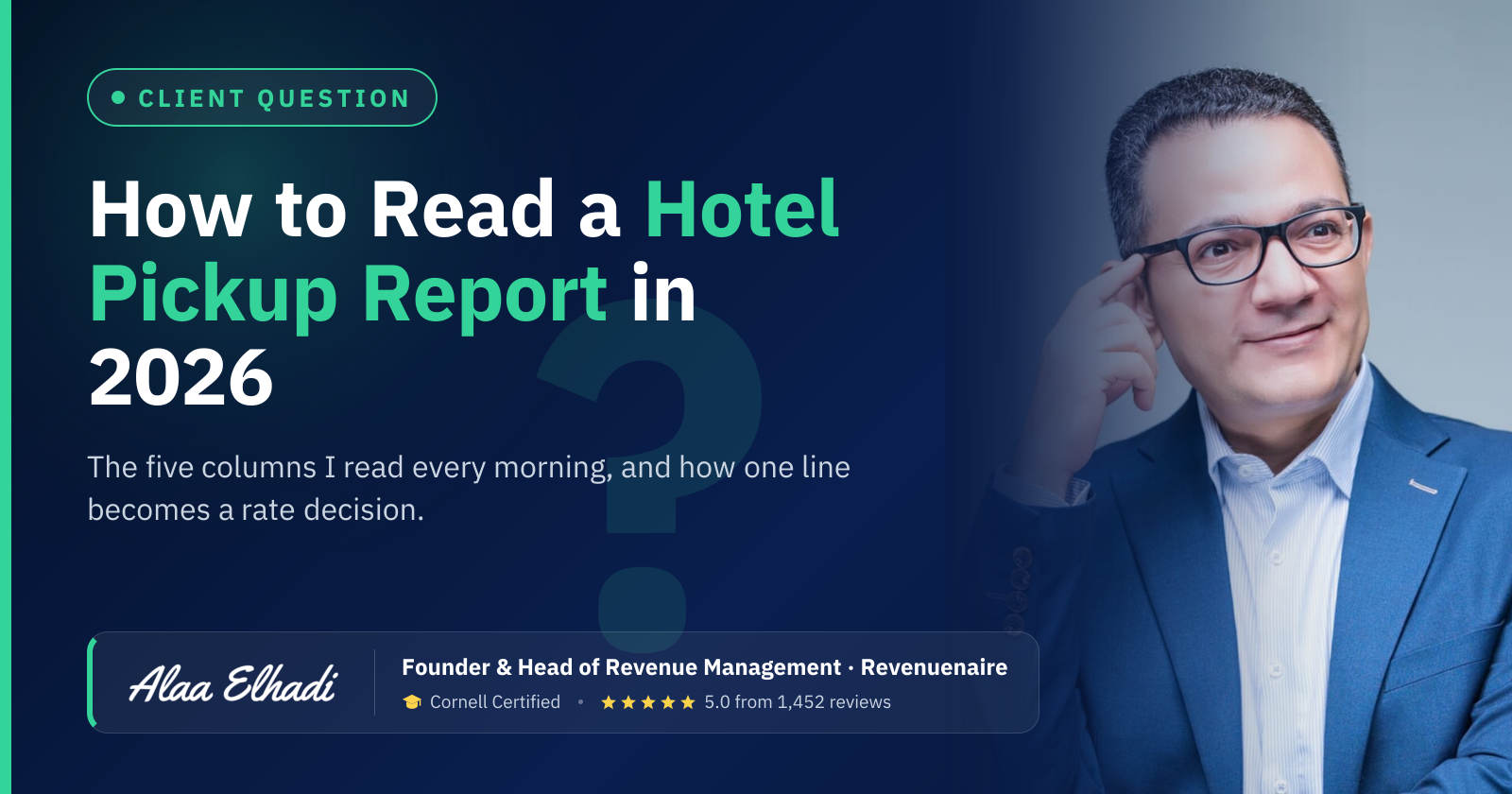
A hotel pickup report can have twenty columns, but five of them carry almost every decision. I read rooms on the books, net pickup over seven days, the same pickup last year, revenue pickup with its implied ADR, and remaining sellable rooms. Everything else in the report is context for those five numbers.
1. Rooms on the books
This is your position today. On its own it tells you little, because 50 rooms on the books 60 days out and 50 rooms on the books 3 days out are completely different stories. I read it only next to days before arrival.
2. Net pickup, last 7 days
Seven days is the window I trust most for decisions. One-day pickup is noisy: a single group block or one cancellation distorts it. Thirty-day pickup is too slow to act on for dates inside a month. Seven days smooths the noise and still gives you time to react.
3. Same pickup last year
This is where pickup meets pace. If you picked up 8 rooms for a Saturday this week and picked up 4 for the equivalent Saturday last year at the same lead time, your momentum has doubled. That comparison is more useful than any absolute number.
4. Revenue pickup and implied ADR
Divide revenue pickup by room pickup and you get the average rate of the business you just took. When I audit a hotel's reporting, this is the column most teams have never calculated. If your seven-day pickup is 10 rooms at an implied ADR of 140 dollars while your published rate is 185 dollars, the pickup came from a discount, a package or an opaque channel, and the headline number is flattering you. In a year when CoStar and Tourism Economics expect US ADR to grow 3.1 percent, business taken 45 dollars below the public rate is moving against the market, not with it.
5. Remaining sellable rooms
Capacity minus rooms on the books minus out-of-order rooms. This tells you how much inventory the next decision affects. A 30 dollar rate increase on 4 remaining rooms and on 40 remaining rooms are not the same decision.
Here is the morning checklist I give every hotel team we work with:
- Filter the report to the next 90 days, which covers the 2026 average lead times reported by Cloudbeds and SiteMinder with room to spare.
- Sort by days before arrival, not by calendar date.
- Flag every date where 7-day net pickup is double, or half, last year's pickup at the same lead time.
- Calculate implied ADR on every flagged date.
- Check cancellations separately on any date with more than three.
- Split the flagged dates by segment and channel before deciding anything.
- Write down the action and the reason next to the date, so next week's reading can check whether it worked.
Bottom line: Five columns, read in the same order every morning, will tell you more than a twenty-column report scanned in a hurry.
Why does net pickup beat gross bookings?
Net pickup beats gross bookings because gross bookings ignore cancellations, and cancellations are now a large share of hotel booking activity. Net pickup is new bookings minus cancellations for the same period, so it measures the business that is actually still coming. A hotel that reads gross bookings will overestimate demand on exactly the dates it is about to overprice.
The scale is not small. SiteMinder's Hotel Booking Trends 2026 report puts the global cancellation rate at 19.15 percent. The Cloudbeds 2026 report shows the gap by channel: 21.8 percent of OTA bookings cancelled in 2025, compared with 10.6 percent of direct bookings, and OTAs held a 63.4 percent share of independent hotel bookings. In other words, most of an independent hotel's bookings come through the channel that cancels at twice the rate.
How I split the pickup line
I ask for three numbers per date instead of one: gross new bookings, cancellations and net change. A date with 14 new bookings and 5 cancellations (net 9) and a date with 9 new bookings and 0 cancellations (net 9) look identical on a basic report. They are not. The first date has a cancellation habit, often from a flexible OTA rate, and its 9 rooms are less certain than the second date's 9.
Cancellations arrive later than they used to
The Cloudbeds report puts the average cancellation window at 39 days in 2025. That matters for how you read the report: a date 45 days out that looks strong can still lose a meaningful share of its rooms before arrival. When I ran revenue in five-star hotels, we kept a simple habit: for any date more than 30 days out, we mentally discounted OTA flexible business by its historical cancellation rate before calling a date strong. That habit is even more useful now.
Bottom line: If your pickup report does not show cancellations as their own column, it is showing you a better hotel than the one you will actually run on the night.
Hotel pickup by segment and channel
Hotel pickup by segment and channel is the version of the report that explains why a date moved. Total pickup tells you that bookings changed; the segment and channel split tells you which guests caused it, at what rate and through which cost of acquisition. A rate decision without this split is a guess about who is booking.
I use four segment buckets for most independent hotels: retail transient (the public rate), discounted transient (packages, member rates, OTA promotions), negotiated corporate or local accounts, and group. For channels, I want direct web, voice and walk-in, each major OTA separately, and GDS if the hotel has corporate business.
What each split usually reveals
- Group pickup hides transient weakness. A 20-room block can make a soft week look fine. I always read transient pickup with groups removed.
- A group wash looks like a demand collapse. When a block releases rooms, the total goes negative overnight. That is inventory returning, not guests leaving.
- A lost corporate account shows up as a missing weekday. If Tuesday and Wednesday pace is behind but weekends are fine, check the corporate segment before cutting the public rate.
- An open OTA promotion shows up as low implied ADR. Strong pickup at a rate well below your public rate usually means a campaign or member deal is doing the selling.
Length of stay belongs in the split too. The Cloudbeds 2026 report found that one- and two-night stays make up more than two-thirds of bookings, while 7-night bookings rose 25 percent year over year. A week of pickup driven by long stays fills several dates at once, so I read it by arrival date and by nights, not just by room count.
Channel matters for cost as well as certainty. The Cloudbeds report found that OTA share of independent hotel bookings reached 63.4 percent in 2025, with some markets approaching 80 percent. Commissions on that share come off your net revenue, so a week of strong OTA pickup and a week of strong direct pickup do not produce the same money even when the room count matches. If channel cost is a recurring gap for your property, our hotel pricing strategy work is where we set rate rules per channel and segment.
Bottom line: Split pickup by segment and channel before every rate decision, because the same total can come from very different guests paying very different net rates.
Hotel pickup report in a worked example
This hotel pickup report example uses an 80-room independent hotel reading one Saturday 28 days before arrival in 2026. The numbers are illustrative, not a client's results. It shows how pickup, pace, implied ADR and remaining inventory combine into one rate decision, with the revenue arithmetic for holding the rate or raising it.
The snapshot
- Capacity: 80 rooms.
- Rooms on the books today: 46, at an average rate of 182 dollars, so 8,372 dollars of revenue on the books.
- Rooms on the books 7 days ago: 38. Gross new bookings: 13. Cancellations: 5. Net pickup: plus 8.
- Same Saturday last year, same 28 days out: 41 rooms on the books, 7-day net pickup of plus 4, and the date finished at 72 rooms.
Reading it
For context, CoStar and Tourism Economics forecast full-year 2026 US occupancy of 63.1 percent, so a Saturday finishing at 90 percent is a compression night by any national measure. Pace: 46 rooms against 41 last year is plus 5 rooms, or 12.2 percent ahead. Pickup: plus 8 against plus 4 last year is double the momentum. Implied ADR on the new business is close to the average on the books, so the pickup is not coming from a discount. Cancellations of 5 in a week are within normal range for a date with heavy OTA share. Last year this Saturday picked up 31 rooms from 28 days out to arrival (72 minus 41). If this year picks up the same 31, the hotel reaches 77 rooms, 96.25 percent occupancy.
The two options
Option A, hold 182 dollars. The hotel sells 31 more rooms at 182 dollars: 77 rooms times 182 dollars equals 14,014 dollars of room revenue. RevPAR is 14,014 divided by 80, or 175.18 dollars.
Option B, raise the remaining inventory to 209 dollars. Assume the higher rate costs 2 rooms, so the hotel sells 29 more instead of 31. Revenue is 8,372 dollars already booked plus 29 times 209 dollars (6,061 dollars), a total of 14,433 dollars. Occupancy is 75 rooms, 93.75 percent. ADR is 192.44 dollars and RevPAR is 180.41 dollars.
Option B earns 419 dollars more on one night with two fewer rooms to clean. Repeat that decision on 10 strong Saturdays in a quarter and it is 4,190 dollars of extra room revenue, before the lower cost per occupied room is counted.
When the same report says do not raise
Change one number and the answer flips. If those 13 gross new bookings had come at an implied ADR of 145 dollars from an OTA promotion, the "strong" pickup would be a discount doing its job, not demand outrunning price. The right move then is to close the promotion for that date first and read the next seven days before raising the public rate. The arithmetic only works when the pickup is priced at, or near, your public rate.
Bottom line: In this 2026 example, reading pickup and pace together justified a 27 dollar increase that added 419 dollars on one night, but only because the implied ADR proved the demand was real.
How do I turn pickup into a rate decision?
Turning hotel pickup into a rate decision takes four steps: compare this date's pickup and pace with last year at the same lead time, confirm the implied ADR of the new business, check which segment and channel it came from, and then move rate, restrictions or visibility on the remaining inventory, sized to the rooms left.
My decision rules by lead time
- 60 to 90 days out: act only on large signals, such as pickup at double last year's pace or a new citywide event. Early rate moves here set your ceiling for the date.
- 30 to 60 days out: the most important window in 2026, since Cloudbeds reports North American travellers book 48 days ahead on average. This is where I make most rate increases.
- 7 to 30 days out: adjust rate in smaller steps, add or remove minimum stays, and close discounted rates on strong dates.
- Inside 7 days: focus on remaining inventory and last-minute demand, and never cut rate on a date that is pacing ahead just because today's pickup was quiet.
I covered the timing side of this in my piece on how often a hotel should change rates. The pickup report is what tells you which dates earn one of those changes. The rule I repeat to every team: price moves follow evidence, not nerves. A single quiet day on a date that is 12 percent ahead of last year is not evidence.
When weak pickup is not a price problem
If pickup is behind and the implied ADR is normal, the first question is visibility, not rate. Is the hotel closed out on a channel by mistake? Is a room type missing from an OTA? Did a corporate account move? Only once those are ruled out do I test a rate move, and when I do, I move the rate for the specific dates that are behind rather than dropping the whole month. If ADR is sliding at the same time, my guide on why a hotel's ADR is dropping walks through how to tell a rate problem from a mix problem.
A pickup report also feeds your forecast. Our team at Revenuenaire has written about measuring hotel demand forecasting accuracy, and the link is direct: a forecast that ignores pickup trends is a forecast built on last year's calendar.
Bottom line: A rate change is justified when pickup, pace and implied ADR all point the same way; when they disagree, fix visibility or mix before touching price.
Pickup report mistakes I see in audits
The pickup report mistakes I see most often in hotel audits are reading gross instead of net bookings, comparing against the wrong last-year date, ignoring group blocks, reacting to one-day pickup, and never recording what action followed. Each mistake is small, but together they turn the most useful report in a hotel into a daily ritual that changes nothing.
1. Comparing calendar dates instead of days of week
Saturday 14 November 2026 should be compared with the equivalent Saturday of 2025, not with 14 November 2025, which fell on a Friday. Many default reports compare calendar dates, and every weekend comparison is quietly wrong.
2. Forgetting last year's events
A pace gap against a date that had a concert, a conference or, for US host cities in 2026, a World Cup match is not a signal. I keep an events column next to the report so nobody reacts to a comparison that was never fair. CoStar reports that US hotels sold 11.4 million more room nights in the first half of 2026 than in the same period of 2025, helped by the World Cup and America 250 celebrations, which makes 2027 comparisons against those dates especially misleading.
3. Letting groups hide transient
Group pickup and group wash distort the total more than anything else. Transient pickup with groups removed is the number that tells you about public demand.
4. Reacting to one day
One-day pickup of zero on a Tuesday 40 days out means nothing. I only act on seven-day trends unless a date is inside a week or a genuine news event hits the market.
5. No decision log
The most common gap I find in hotel audits is that nobody writes down what they did with the report. Without a log, you cannot tell whether last month's rate increase cost bookings or not, and the same debate repeats every week. A single column, "action and reason", fixes it.
These mistakes are also one reason smaller hotels ask whether they need specialist help. I answered that honestly in whether small hotels need revenue managers, and the short version is that the report itself is easy; the discipline of reading it every day is what most teams lack.
Bottom line: Most pickup report failures in 2026 are reading failures, not data failures, and a decision log catches almost all of them.
Frequently Asked Questions
What is a good pickup in hotel revenue management?
A good pickup in hotel revenue management is pickup that beats the same date last year at the same lead time, on net bookings, at or near your public rate. There is no universal number: ten rooms a week is strong for a 60-room hotel and weak for a 400-room hotel, so judge pickup against your own history.
How often should I run a hotel pickup report?
Run a hotel pickup report every morning for the next 90 days, and review a weekly summary for the next 12 months. Daily reading catches fast-moving dates inside 30 days, while the weekly view shows longer trends, group movement and early demand for peak periods and events.
What is the difference between pickup and pace in a hotel?
Pickup is the change in rooms or revenue on the books for a future date over a recent period, such as the last seven days. Pace is the total on the books for that date compared with the same point in the booking cycle last year or with budget. Pickup measures speed; pace measures position.
Should a pickup report include cancellations?
Yes, a pickup report should show cancellations as their own column next to new bookings and net change. The Cloudbeds 2026 State of Independent Hotels Report found OTA bookings cancelled at 21.8 percent in 2025, so a report showing only gross bookings overstates demand on the dates where decisions matter most.
What pickup window should a hotel use?
Most hotels should use a seven-day pickup window for rate decisions, with one-day pickup for dates inside a week and 30-day pickup for dates more than 60 days out. Seven days removes most single-booking noise while still leaving time to change rates before the date fills.
Can a pickup report tell me when to lower rates?
A pickup report can tell you when a date is behind, but not by itself whether to lower rates. When pickup and pace are both behind at a normal implied ADR, check channel visibility, room type availability and segment losses first. Lower the rate only on the specific dates still behind after those checks.
Do I need a revenue manager to read pickup reports?
A hotel under about 30 rooms with a stable market can usually read its own pickup report with a daily routine and a decision log. Larger hotels, or any hotel with groups, several OTAs and event-driven demand, benefit from a specialist. Alaa Elhadi and the Revenuenaire team read pickup and manage rates daily for hotels worldwide.
My Verdict
The pickup report is the most honest document in a hotel, and in 2026 it is the one most often misread. Read net pickup, not gross. Put pickup and pace on the same line. Check the implied ADR before you believe any strong week. Split by segment and channel. Then write down what you did and why. Do those five things every morning and the report stops being a printout and starts being the source of your best rate decisions of the year.
If you would like a second pair of eyes on your own pickup report, book a call with Alaa's team and we will walk through it with you.