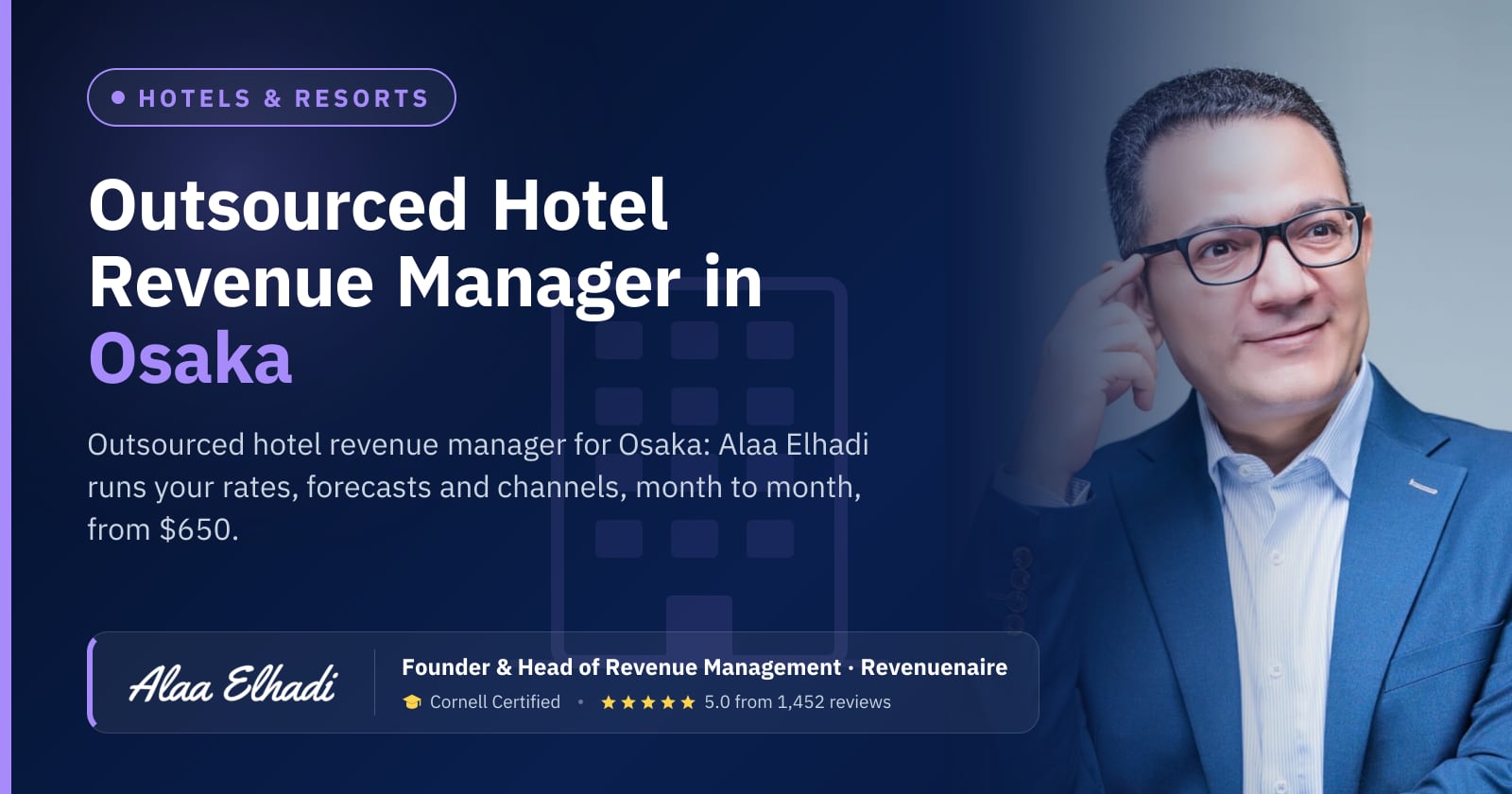
Your hotel's revenue manager, without the full-time hire.I take over the revenue manager role for Osaka hotels, resorts and serviced apartments: daily rates, restrictions, forecasting and distribution, with a monthly report you can check. Plans start from $650 a month by hotel size, month to month, remote in Japan Standard Time (UTC+9).
Outsourced Hotel Revenue Manager in Osaka at a glance
Alaa Elhadi, an independent revenue management consultant, provides outsourced hotel revenue management for hotels, resorts and serviced apartments in Osaka, Japan, one to one, remotely and in Japan Standard Time (UTC+9). In Osaka, I price Late March to early May and October to early December as the peak and January to February as the quiet time, and I build the work around that calendar. Hotel revenue management plans are priced monthly by hotel size, with Core from $650 a month, Plus adding channel and segment optimization and Pro adding forecasting and a monthly strategy call. They run month to month and are never a percentage of revenue.
What is outsourced hotel revenue management in Osaka?
Outsourced hotel revenue management means I do the job of the revenue manager for you: I watch the comp set and pace every day, move rates and restrictions, manage the OTAs, forecast demand and report each month. You keep control of the hotel and see every decision.
What I plan around in Osaka: Cherry blossom and autumn seasons; Gion Matsuri; Universal Studios Japan; Expo and convention travel. Guests I price for: International travellers on 3 to 6 night stays. Where I start: Sakura and autumn premiums, minpaku 180-night strategy, and Kyoto minimum-stay rules.
For Osaka and Kyoto hotels and ryokan I work on segmenting international, domestic and group guests, setting fences for sakura and autumn, and balancing Japanese and international channels, so peak dates sell at full value and quieter months still attract the right guests.
The service in general is described on my outsourced revenue management page; this page covers how I apply it in Osaka.
Included
What I run for a hotel on a monthly plan in Osaka
Daily rates and restrictions
I monitor your comp set and booking pace every day and move rates, rate plans and restrictions as demand shifts, room type by room type.
BAR and rate-plan strategy by room type
Seasonal, event and day-of-week rules
Length-of-stay and minimum-stay restrictions
Closed-to-arrival and stop-sell logic
Distribution and OTAs
I manage the channel mix, parity and promotions together across Booking.com, Expedia, Agoda, Google and your own site, so cost of sale does not eat the gain.
OTA and metasearch optimization
Rate-parity checks and promotions
Segmentation across OTA, direct and corporate
Channel manager and PMS mapping
Forecasts and budgets
On the higher plans I forecast demand by month and segment, build the annual budget and keep a 12-month pricing calendar tied to the market's real dates.
12-month demand forecast
Annual budget and re-forecast
Group, corporate and event rate strategy
Pace and displacement analysis
Reporting and strategy calls
You get a monthly performance summary, a full ADR, occupancy and RevPAR report on Plus and Pro, and on Pro a monthly strategy call and a quarterly review.
“Osaka and Kyoto have very different rules. Kyoto restricts private rentals in residential zones heavily and raised its accommodation tax sharply, while Osaka's special-zone system requires at least two-night stays. Sakura, autumn colours and Gion Matsuri drive peaks in both.”
Alaa Elhadi, revenue management consultant. Cornell certified, 18 years in hotel and short-term rental revenue.
Osaka at a glance
Busiest
Late March to April (sakura), Golden Week, October to November (autumn colours), and Gion Matsuri in July.
Quietest
January to February and June rainy season.
Dates to price first
Cherry blossom and autumn seasons
Gion Matsuri
Universal Studios Japan
Expo and convention travel
How I price it
My Osaka calendar, and what I do in each period
January to FebruaryLow
Cold weather slows travel except around Lunar New Year visitors from China and Korea, so I lower floors, keep short minimums and highlight heated rooms and nearby onsen access.
Late March to early MayPeak
Sakura and Golden Week bring the highest demand, so I raise rates well ahead, set minimum stays where rules allow and avoid any late discounts.
June to mid-JulyShoulder
Rainy season softens leisure travel, then Gion Matsuri in July lifts Kyoto, so I price the festival days above the rest and keep Osaka focused on Universal Studios families.
Late July to SeptemberShoulder
Hot, humid weather and typhoons slow sightseeing, so I keep rates steady, highlight air conditioning and target families on summer holidays heading to Universal Studios.
October to early DecemberPeak
Autumn colours and comfortable weather bring the second peak, so I raise rates and set firm minimums, especially in Kyoto near temples and gardens.
Late DecemberHigh
Year-end holidays bring domestic and international visitors, so I price the New Year period above early December and keep minimums of two or three nights.
Where I price differently in Osaka
Higashiyama and Gion (Kyoto)
Temples, traditional streets and festival crowds; I price sakura, Gion Matsuri and autumn as top bands and keep strict minimums where rules allow.
Namba and Dotonbori (Osaka)
Food, nightlife and easy airport access; I price for short stays and use events and concerts to lift weekends.
Bay Area and Universal City (Osaka)
Family demand for Universal Studios Japan; I price school holidays and weekends higher and highlight family-friendly room layouts.
What I check first in Osaka
Which licence the property runs under and what operating limits it carries, because Kyoto residential zones and Osaka special zones can restrict when and how stays are sold.
How the listing shows walking time to stations on the Hankyu, Keihan and JR lines, since guests choose by transit access before price.
Whether the accommodation tax is included in the displayed total on each channel, because guests compare totals and mismatches make the listing look more expensive.
Pricing playbook
5 pricing moves, and 3 mistakes, in Osaka
1
Confirm whether the property runs under minpaku, special-zone or hotel licensing.
2
Price sakura and autumn colours as top bands.
3
Add Gion Matsuri in July for Kyoto.
4
Include Kyoto's accommodation tax in total price.
5
Use 2-night minimums where special-zone rules require.
Mistakes I fix in Osaka
Kyoto and Osaka rules treated as the same.
Accommodation tax ignored.
Minimum-stay rules ignored.
Who it is for
When outsourced hotel revenue management makes sense in Osaka
No revenue manager
The role left or was never hired, and rooms are priced between other duties.
Results have plateaued
RevPAR has stopped moving while the comp set keeps learning.
More than one property
You want one consistent method across a small group without building a department.
An owner or asset manager
You want decisions made by a specialist and reported in numbers you can check.
How it works
From first message to results in Osaka
01
Tell me about the hotel
Room count, room types, channels and the systems you use. I confirm the plan level and the monthly price for your size.
02
I build the strategy
I study your market, comp set and current rates, set up the strategy and connect your PMS or channel manager and pricing tool.
03
I price it every day
I adjust rates, restrictions and promotions as demand moves, and manage your OTAs on Plus and Pro.
Step 4
We review each month
You get the report against budget and last year, and on Pro we meet monthly, so nothing I do is hidden.
Pricing
Hotel plans and prices
Priced monthly by your hotel's size, not per room. Core, Plus and Pro, month to month, never a percentage of revenue. Hotels of 200 or more rooms, luxury properties and groups are quoted individually.
Option
What you get
Price
Core, up to 20 rooms
Managed pricing, run for you every day
From $650/mo
Plus
Pricing plus OTA, channel and segment optimization
By hotel size
Pro
Full revenue management with forecasting and a monthly strategy call
Real feedback from PriceLabs pricing strategy sessions with Alaa.
★★★★★
Savvy adjustments to my dynamic pricing
Alaa is a consummate professional! Patient, thorough, efficient and effective in communicating. He not only made savvy adjustments to my dynamic pricing strategy, but also helped me to understand the reasoning behind his methods, granting me a better understanding of the PriceLabs platform. Strong work!
Airbnb host
★★★★★
Great PriceLabs advice for every property
Alaa was fantastic, going through each of the properties I had and gave great advice and actioned a great game plan. Would highly recommend for anyone looking to enhance their pricing strategy on PriceLabs. Alaa's experience goes beyond this which makes it very beneficial to have this holistic approach.
Property manager
★★★★★
Helped me optimize my PriceLabs
Alaa helped me optimize my PriceLabs settings for my Airbnb listing and was very helpful and patient with answering any questions I had. He was also able to clearly explain why he made the changes he made, and it was obvious that he had a lot of experience in this field. I will definitely be back!
Airbnb host
FAQ
11 questions about outsourced hotel revenue management in Osaka
When is Osaka busiest, and how do you price outsourced hotel revenue management around it?
Busiest in Osaka: Late March to April (sakura), Golden Week, October to November (autumn colours), and Gion Matsuri in July. Late March to early May: Sakura and Golden Week bring the highest demand, so I raise rates well ahead, set minimum stays where rules allow and avoid any late discounts. October to early December: Autumn colours and comfortable weather bring the second peak, so I raise rates and set firm minimums, especially in Kyoto near temples and gardens. For outsourced hotel revenue management, i raise floors and tighten minimum stays ahead of these windows and review pace every week, so the strongest dates never sell early at a shoulder rate.
What do you check first on a Osaka property when it comes to outsourced hotel revenue management?
For outsourced hotel revenue management, that is the first thing I check before taking on the pricing, because everything else sits on top of it. How the listing shows walking time to stations on the Hankyu, Keihan and JR lines, since guests choose by transit access before price.
What is the first pricing move you would make in Osaka?
Add Gion Matsuri in July for Kyoto. Next: use 2-night minimums where special-zone rules require. For outsourced hotel revenue management, i start with base rates, the seasonal calendar and restrictions, because that is where a Osaka property usually leaks the most.
What do you do in Osaka's quiet months?
For outsourced hotel revenue management, in the quiet months my job is to protect the floor, close gaps with length-of-stay and last-minute rules, and keep the property visible on every channel. Quietest in Osaka: January to February and June rainy season. January to February: Cold weather slows travel except around Lunar New Year visitors from China and Korea, so I lower floors, keep short minimums and highlight heated rooms and nearby onsen access. June to mid-July: Rainy season softens leisure travel, then Gion Matsuri in July lifts Kyoto, so I price the festival days above the rest and keep Osaka focused on Universal Studios families.
What mistakes do you see most often in Osaka?
Accommodation tax ignored and minimum-stay rules ignored. I look for these first when I review outsourced hotel revenue management in Osaka, and fixing them is usually the quickest gain.
Which booking channels matter most in Osaka?
For outsourced hotel revenue management in Osaka, i manage channel mix, parity and promotions together, so the cheapest route to a booking is not the most expensive one for you. Osaka sells mostly through Airbnb, Booking.com, Agoda and Rakuten Travel. January to February: Cold weather slows travel except around Lunar New Year visitors from China and Korea, so I lower floors, keep short minimums and highlight heated rooms and nearby onsen access.
Which parts of Osaka do you treat differently for outsourced hotel revenue management?
Higashiyama and Gion (Kyoto): Temples, traditional streets and festival crowds; I price sakura, Gion Matsuri and autumn as top bands and keep strict minimums where rules allow. Namba and Dotonbori (Osaka) and Bay Area and Universal City (Osaka) get their own treatment. For outsourced hotel revenue management, i set rates, comp sets and restrictions per area and per room or listing type, not as one citywide number.
Which dates and events in Osaka do you price first?
Expo and convention travel, Cherry blossom and autumn seasons and Gion Matsuri are the dates I price first for outsourced hotel revenue management in Osaka. Late July to September: Hot, humid weather and typhoons slow sightseeing, so I keep rates steady, highlight air conditioning and target families on summer holidays heading to Universal Studios.
Why hire a consultant for outsourced hotel revenue management in Osaka instead of an agency or an in-house hire?
For outsourced hotel revenue management, you get one experienced person who knows your numbers, with a small team and a tool stack behind me, and no account-manager layer in between. I have optimized 100+ properties in and around Osaka and work remotely in Japan Standard Time (UTC+9). Locally, that shows up in decisions like this: price sakura and autumn colours as top bands.
How much does outsourced hotel revenue management in Osaka cost, and how do I start?
Hotel revenue management plans are priced monthly by hotel size, with Core from $650 a month, Plus adding channel and segment optimization and Pro adding forecasting and a monthly strategy call. They run month to month and are never a percentage of revenue. The scope of outsourced hotel revenue management is the same in every market, but the plan is not: in Osaka I would start from October to early December: Autumn colours and comfortable weather bring the second peak, so I raise rates and set firm minimums, especially in Kyoto near temples and gardens. To start, open the chat or email me with your property type and size in Osaka.
Can you work with an Osaka property remotely, in my time zone?
Yes. Outsourced Hotel Revenue Manager in Osaka is delivered remotely and scheduled in Japan Standard Time (UTC+9), and 100+ properties in and around Osaka have been optimized, including in areas such as Namba and Dotonbori (Osaka). I work in your time zone, report monthly, and the engagement runs month to month with no long-term lock-in. Start in the chat or by email and tell me what you run in Osaka.
More in this market
Everything else I do in Osaka
The other services I offer in Osaka, for hotels and for Airbnb and short-term rentals. Each has its own page for this market.